How Are Cell Phones Used to Help Spend Quality Time With Family
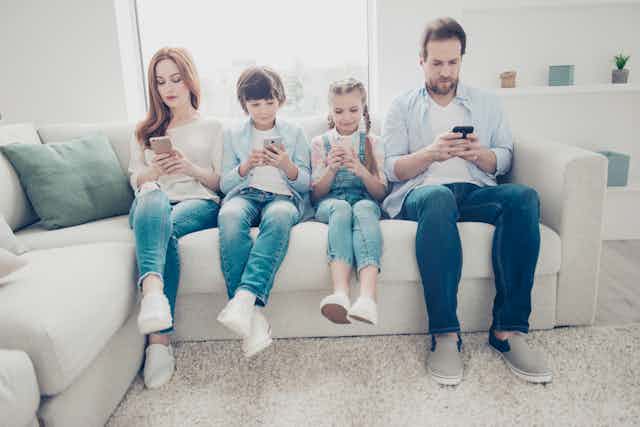
Alone together: how mobile devices have changed family time
Penulis
-

Associate Professor in Sociology, Academy of Warwick
-

Lecturer Sociology and Policy, Aston University
Pengungkapan
Stella Chatzitheochari has received funding from the Economical and Social Inquiry Quango.
Killian Mullan tidak bekerja, menjadi konsultan, memiliki saham, atau menerima dana dari perusahaan atau organisasi mana pun yang akan mengambil untung dari artikel ini, dan telah mengungkapkan bahwa ia tidak memiliki afiliasi selain yang telah disebut di atas.
Mitra


University of Warwick memberikan dana sebagai mitra pendiri The Conversation United kingdom of great britain and northern ireland.
Aston Academy memberikan dana sebagai anggota The Conversation Great britain.
Lihat semua mitra
There is at present widespread concern about the amount of time children spend staring at screens – with many people worried most the negative impacts mobile devices might have on wellness and well-beingness.
Concerns have also been raised nearly the influence of technological alter on relationships and face up-to-face interactions. Sherry Turkle, a professor of the social studies of scientific discipline, came upwardly with the famous term "lonely together" – which is also the name of her book. "Solitary together" captures this thought of spending time on devices to the neglect of interacting with those who are physically nearby.
Many people believe that technological changes accept had a detrimental touch on the fourth dimension family members spend together – with "alone together" fourth dimension colonising family life. Nonetheless, to engagement, very few studies take actually been done in this area.
Our new research looks to change this, by providing the first real insight into how technology has impacted the fashion families spend their time in the UK. To do this, we analysed time diaries nerveless by parents and children aged eight to 16 years-one-time in 2000 then again in 2015 – a menstruation that has witnessed rapid technological change.
More time at home and alone
Reverse to expectations, we constitute that children spent more than time around their parents in 2015 than in 2000. This equates to merely over one-half an 60 minutes extra a day (347 minutes per day in 2000 and 379 minutes in 2015). Notably, all of this additional time most parents was spent at home.
This was a surprising finding. But looking closer, we found that children reported they were "solitary" during all of this boosted time at habitation with their parents. In this sense then, "alone together" fourth dimension has increased.
Our analysis too showed some relatively pocket-size changes in time for shared family activities, with gimmicky families spending less time watching TV and more fourth dimension on leisure activities and family meals. But the overall time spent in shared activities has remained the aforementioned.
Our data shows that mobile device use cuts across all aspects of family unit fourth dimension. We constitute that children and parents both spent approximately the aforementioned amount of time (effectually 90 minutes) using mobile devices when together.
We constitute all these patterns to be specially pronounced among young people anile 14 to 16. Young people in this group spent around one hour more at abode "alone" with their parents in 2015 than in 2000. Mobile device use when near their parents was also more frequent and heavily full-bodied.
Lack of quality time?
Academics have long noted the capacity for technology to bring families together at abode. And while our research does seem to indicate this could exist the case, this increment in time at dwelling may also be associated with other issues such as the parent's concerns for their children'south prophylactic. Inquiry in the US finds similar patterns of alter – with teens spending less time outside the home abroad from their parents.
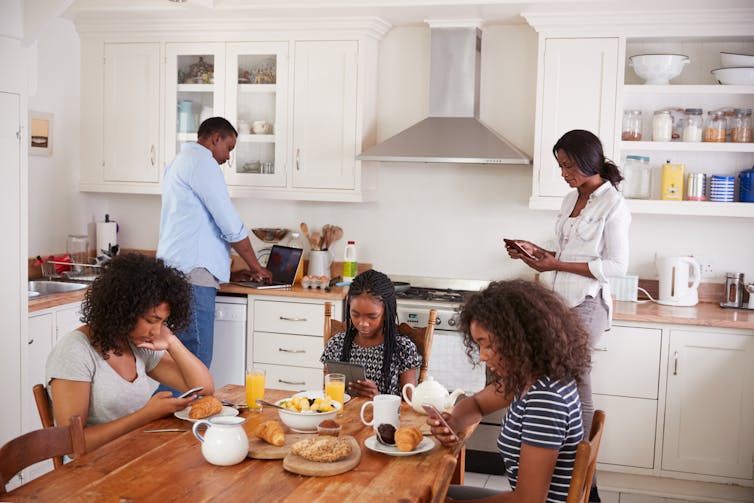
There is increasing evidence that the mere presence of a telephone negatively affects face-to-face interactions. This may go some way then to explain parents' perceptions of decreasing family cohesion and fourth dimension together with their children, reported in earlier studies.
Indeed, nosotros institute that both children and parents were using mobile devices during family unit meals, television viewing, and other activities. And so fifty-fifty though this was for a relatively small corporeality of time, it may take a asymmetric impact on the quality of this time for family members.
Of course, in some cases, it is possible that mobile devices are in fact complementing family interactions. If, for case, family unit members use them for video streaming, to play grouping games or to contact other relatives. And further enquiry on mobile device employ and content is now necessary to help ascertain their full bear upon on daily life and move across commonly held negative assumptions.
But what is clear, is that although a ascent in "alone together" time means families now spend more than fourth dimension at habitation, it is not necessarily in a way that feels like quality time.
Pembaca kami
Jumlah pembaca The Chat sebanyak 18 juta pengguna setiap bulan, dan melalui Creative Eatables republikasi menjangkau 42 juta pembaca.
Mau menulis?
Tulis artikel dan bergabung dengan komunitas akademisi dan peneliti yang terus tumbuh dengan lebih dari 142.200 dari iv.306 lembaga.
Daftar sekarang
Source: https://theconversation.com/alone-together-how-mobile-devices-have-changed-family-time-111478
0 Response to "How Are Cell Phones Used to Help Spend Quality Time With Family"
Enregistrer un commentaire